
Blue Crab Haplotyping
- KEYWORDSsympatric speciation, blue crab, salinity, haplotyping, CO1 barcoding, invasive species, population genetics
- ADVISORDr. Dan Rittschof, Duke University Marine Lab
- WEBSITEhttps://github.com/henrysun9074/consensus
Overview
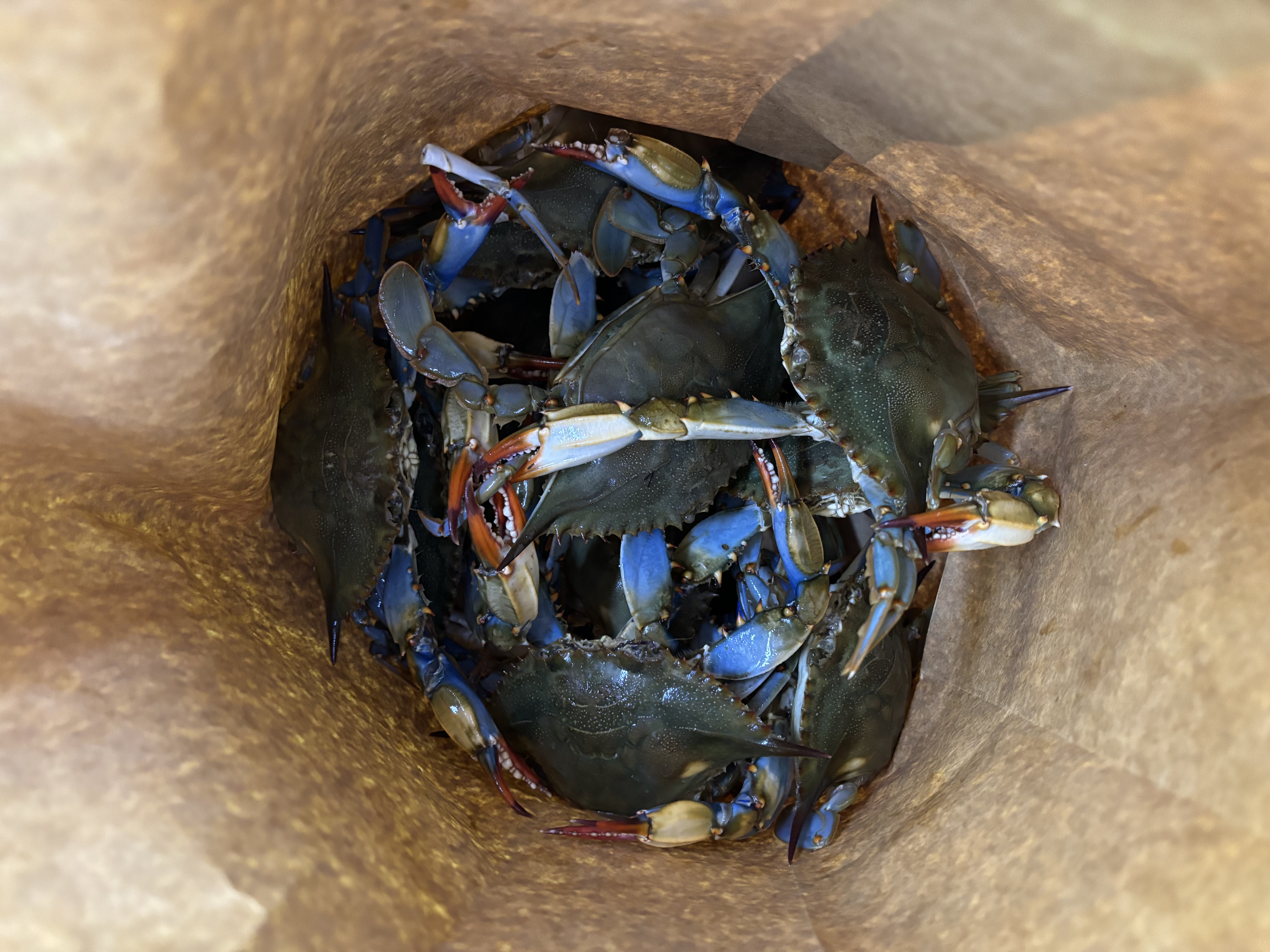
The Atlantic blue crab (Callinectes sapidus), native to the Western Atlantic, has become a widespread invasive species across the Mediterranean Sea. To understand where these invasive crabs are coming from and how they’re spreading, we used CO1 haplotyping to trace the maternal lineages of crabs from Sardinia and Turkey.
Results
We compared COI sequences from blue crabs collected in 2012 from their native Atlantic range and invasive populations in Turkey, with newer samples collected from various North Carolina habitats in 2020 and from Sardinia in 2024. The Turkish crabs all shared a single haplotype, suggesting a strong founder effect or limited genetic variation among individuals that invade freshwater. In contrast, the Sardinian crabs—spawning females from a saltwater channel—showed three distinct haplotypes, indicating a more diverse origin. However, the Sardinian crabs were genetically distinct from those in North Carolina’s Neuse River, suggesting a different source population. These findings highlight a likely genetic component to salinity-based habitat selection in blue crabs and underscore the need to expand COI haplotype mapping across the Mediterranean.
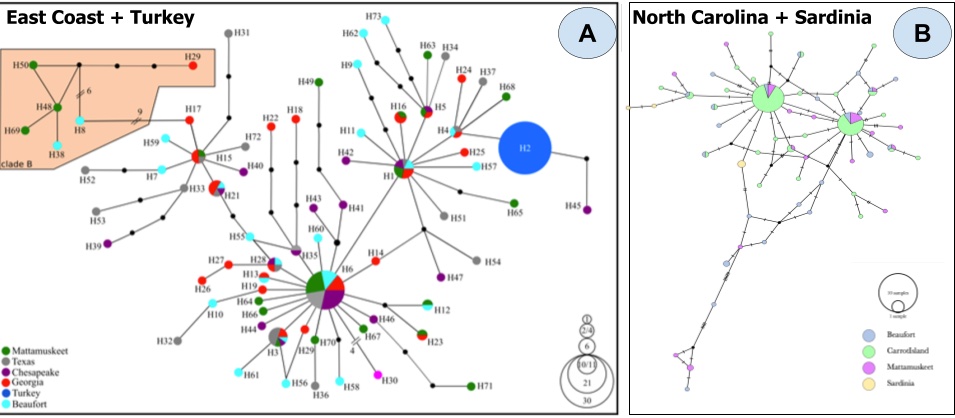
Figure showing distinct haplotypes between different native and invasive populations. Higher quality figure available in poster below. Note the blue circle in (A) showing 30 turkish crabs all sharing one haplotype.
Outputs
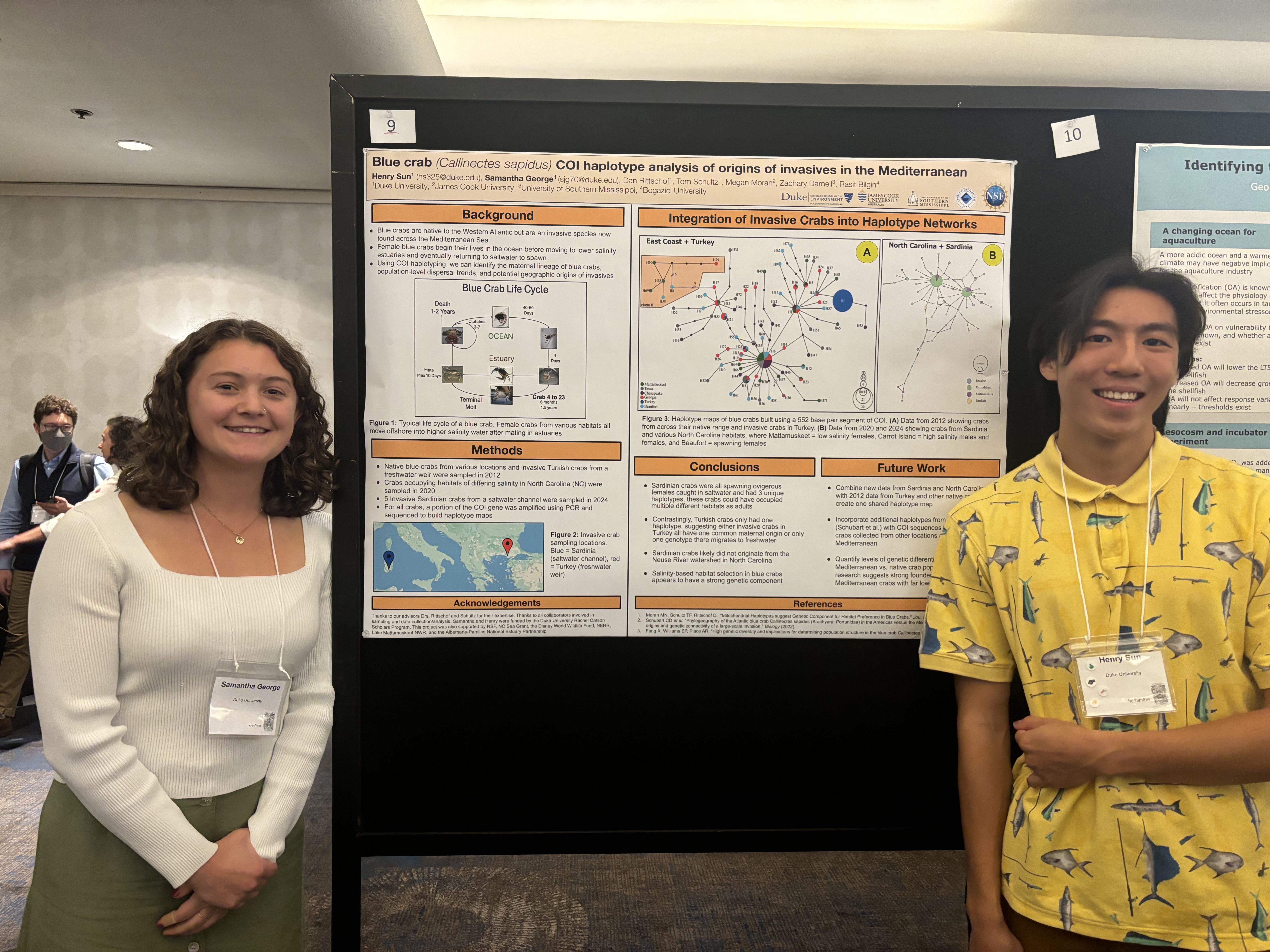
Project poster: click here to open in a new tab. I presented this poster at WSN 2025.
Future Work
Future work will incorporate additional Mediterranean samples and build a comprehensive haplotype map to better understand the scale and structure of this marine invasion. We also hope to pool all the data from this long-term study and analyze larger trends with regards to sympatric speciation. Sympatric speciation refers to the diversification of two lineages into two genetically distinct species while both species still occupy the same geographic region. This process could potentially be ongoing in blue crabs, which have been observed to separate by salinity in estuaries. If low- and high-salinity blue crab genotypes were genetically distinct, then sympatric speciation could be ongoing.